

Analysis Of The Core Manufacturing Process And Processing Technology Of Titanium Flange
Analysis Of The Core Manufacturing Process And Processing Technology Of Titanium Flange
As the core basic accessory for pipeline
connection and sealing and fastening of titanium equipment, titanium flange
blocks are widely used in key fields such as chemical anticorrosion, aerospace,
nuclear power, and high-end equipment manufacturing due to the excellent
characteristics of titanium alloy's lightweight and high strength, high and low
temperature resistance, and corrosion resistance. The finished product
performance, dimensional accuracy and structural stability of titanium flange
blocks directly depend on the selection of manufacturing technology and the
control of machining accuracy.
According to the complexity of product
structure, operating conditions and performance indicators, the mainstream
manufacturing processes in the industry are divided into three core forming
processes: precision casting, multi-type forging, and forming and welding. With
supporting processes such as mechanical finishing and surface modification
treatment, a complete standardized production system of titanium flange blocks
is formed. This paper comprehensively analyzes the technical characteristics,
applicable scenarios and technical advantages of each core process.
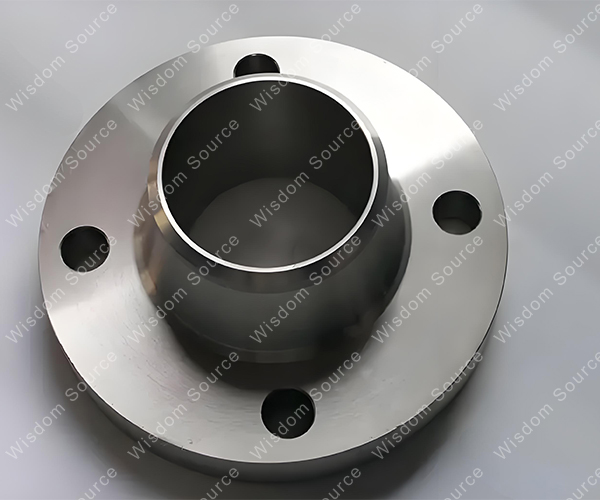
1. Precision Casting Process
Precision casting is the key forming
process of special-shaped and high-complexity titanium flange blocks. It is
mainly aimed at titanium flange products with special internal structure, many
special-shaped curved surfaces, and difficult to form by conventional forging. The
process relies on the principle of lost wax precision casting and forming.
First, high-precision molds and wax molds are made. After a series of processes
such as tree formation, shell making, dewaxing, roasting, vacuum melting,
pouring, cooling and shelling, the blank forming of titanium flanges with
complex structures is completed at once.
Compared with the traditional molding
process, the biggest technical advantage of precision casting is the high
degree of freedom of molding. It can form all kinds of titanium flange blocks
with unconventional pore sizes, special-shaped end faces, and complex cavity
structures in one piece, without the need for a lot of secondary shaping
processing. At the same time, the vacuum pouring environment can effectively
isolate the air, greatly reduce the oxidation and suction defects of the
titanium alloy melt, and ensure that the internal organization of the casting
is uniform and the pores are less slag.
This process is mainly suitable for small
batches of non-standard titanium flange products with special structures and
complex shapes, and can meet the special-shaped assembly needs under special
working conditions. It is the core process of customized high-end titanium
flange production. However, limited by the characteristics of the casting
process, the grain of the casting is relatively thick, and the overall
mechanical properties are slightly lower than that of the forging. It is
generally suitable for non-high pressure and high load working conditions.
2. Forging And Forming Process
Forging is the mainstream manufacturing
process of industrial standard titanium flange blocks, and it is also the
preferred forming method for high-performance and high-load titanium flanges. The
titanium alloy blank is extruded, forged, and plasticically deformed by
external forces, the coarse grains in the cast state are broken, the internal
metallographic structure is refined, and the defects such as looseness and
pores in the blank are eliminated, and the density, strength, toughness and
fatigue resistance of the titanium flange block are greatly improved. According
to the different forming molds, processing methods and process parameters,
titanium flange forging is mainly divided into three categories: open forging,
closed forging, and isothermal forging.
(1) Open Forging
Open forging is a traditional free forging
process, relying on the upper and lower flat anvil molds to repeatedly forge,
crush and shape the titanium alloy blanks. There is no closed setting mold,
relying on manual or equipment to control the deformation shape and size of the
blanks.
The process has flexible operation, low
mold cost and low production threshold, and is suitable for mass production of
ordinary titanium flange blocks with simple structure and conventional
specifications. However, the process accuracy is limited, the product
dimensional tolerances are large, and the flatness and roundness deviations of
the flange end face and aperture are relatively obvious, and a larger machining
margin needs to be reserved in the future. The finished product has stable
comprehensive mechanical properties and high cost performance. It is widely
used in conventional working conditions such as general chemical industry and
civil pipelines.
(2) Closed Forging
Closed forging belongs to the precision die
forging process. A closed setting mold is used to place the titanium alloy
blank inside the mold cavity, and the blank is fully formed by high-pressure
extrusion of the equipment. The cavity is formed.
Compared with open forging, the utilization
rate of closed forging materials is extremely high, there is no excess flying
edge waste, and expensive titanium alloy raw materials are effectively saved.
At the same time, the mold is shaped and formed, the product has high
dimensional accuracy and regular shape, and the flatness and verticality of the
flange end face are consistent, which greatly reduces the margin for subsequent
turning and milling. This process has strict requirements for equipment
pressure, blank deformation speed, and mold accuracy. It is mainly used for the
large-scale production of high-end standardized titanium flanges, and is
suitable for medium- and high-pressure and medium-load industrial conditions.
(3) Isothermal Forging
Isothermal forging is the core process of
high-end precision forming of titanium alloys. It is specially designed for the
customized production of titanium flanges in high-precision fields such as
aerospace, nuclear power, and military industry. The core feature of the
process is that the blank and the mold maintain the same temperature and
constant temperature, and the plastic deformation is completed under a constant
high temperature environment.
The constant temperature environment can
completely avoid the internal stress caused by the temperature difference in
the forging process of titanium alloy blanks, and effectively eliminate product
deformation, cracking, rebound and other problems. After forming, the product
has extremely high dimensional accuracy and minimal deformation. At the same
time, constant temperature and slow deformation can maximize the refinement of
the metallographic structure of titanium alloy, so that the product has the
comprehensive properties of ultra-high strength, high toughness, high
temperature resistance and fatigue resistance. The isothermal forging process
has high cost and long production cycle, and is only suitable for high-end
titanium flange block products with harsh working conditions and high
performance requirements.
3. The Welding And Forming Process
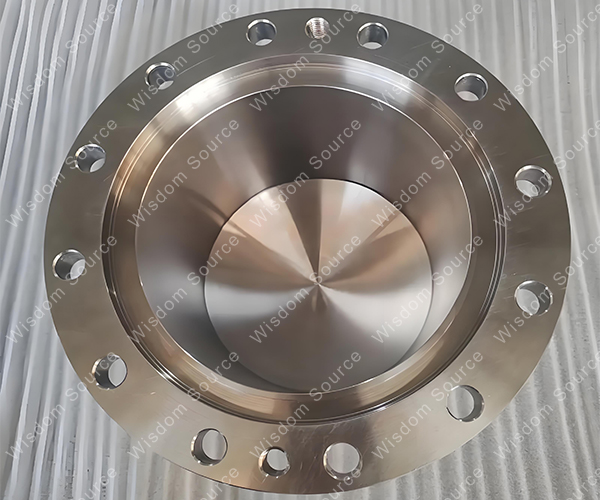
For large-size, ultra-large titanium
flanges and split-structure titanium flanges, the industry generally adopts
welding and forming technology, which is mainly suitable for supporting flange
products for large pressure vessels, large chemical reaction equipment, and
large-caliber piping systems. This kind of large-size flange is difficult to
forge and cast as a whole, and the cost is extremely high. The welding process can
realize split forming and overall splicing, taking into account the production
feasibility and structural strength.
Titanium flange welding is mainly based on
high-quality welding technology, and the mainstream adopts two processes:
tungsten argon arc welding and molten argon arc welding. Inert gas protection
is used throughout the welding process to prevent high-temperature oxidation
and nitriding of titanium alloys, avoid pores, cracks, inclusions and other
defects in the welds, and ensure that the welds are highly consistent with the
mechanical properties and corrosion resistance of the base material.
The titanium flange block after precise
welding and flaw detection has extremely high structural integrity and sealing
performance. The weld strength and sealing properties can meet the special
working conditions of high pressure, strong corrosion, and high sealing
requirements. It is an indispensable forming process for the production of
large-scale special titanium flanges.
4. Supporting Finishing And Surface Treatment Technology
After forming, the titanium flange blank
needs to be optimized for dimensional accuracy, appearance quality and service
performance through finishing and surface treatment processes. It is the key
finishing process for the finished product to leave the factory.
(1) Precision Machining
Whether it is castings, forgings or
welding-formed blanks, there are dimensional deviations and surface margins.
Precision equipment such as CNC lathes, milling machines, drilling machines,
etc. need to be used for turning end faces, fine turning inner and outer
diameters, milling sealing surfaces, drilling and tapping, etc. Finishing
processing. Through standardized CNC machining, the flatness, verticality,
aperture tolerance, and sealing surface roughness of the flange are strictly
controlled to ensure that the product exactly matches the assembly standards
and guarantees the sealing and assembly accuracy of the pipeline connection.
(2) Surface Modification Treatment
The corrosion resistance, wear resistance,
and oxidation resistance of titanium flanges can be further optimized through
surface treatment. Common processes in the industry include sandblasting,
polishing, and anodizing. Sandblasting treatment can remove oxidized skin,
burrs, and impurities on the surface of the blank, and even the surface
roughness; mirror polishing can improve the flatness of the flange sealing
surface and prevent sealing leakage; anodizing can generate a dense oxide film
on the surface of the flange, greatly enhancing the corrosion resistance of the
product under extreme working conditions such as strong acid, alkali, and
seawater, effectively extending the service life of the product.
5. Conclusion
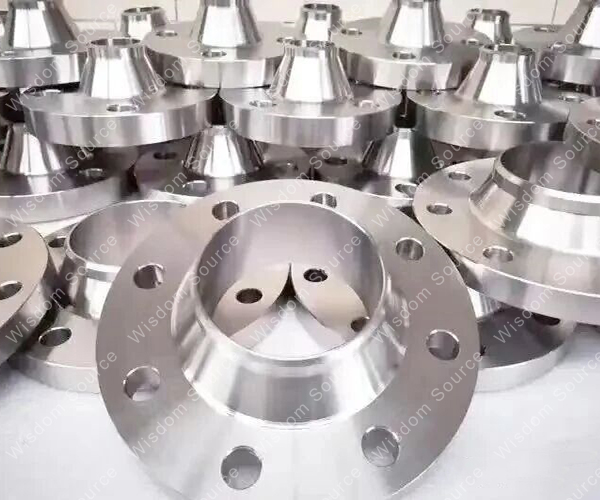
In summary, the manufacturing process of titanium flange blocks needs to follow the principle of on-demand selection and precise adaptation: open forging is preferred for ordinary conventional working conditions, closed forging is used for standardized middle and high-end products, precision casting is used for special-shaped non-standard products, isothermal forging is used for high-end harsh working conditions, and precision welding is used for large-scale products. At the same time, relying on the supporting technology of finishing and surface treatment, the dimensional accuracy, mechanical properties and corrosion resistance of titanium flange blocks are guaranteed in all directions, and they are fully adapted to the long-term stable operation needs of high-end equipment in various fields.