

Surface Treatment Of Titanium Dioxide Alloy: Analysis Of Oscillating Grinding And Polishing Process
Surface Treatment Of Titanium Dioxide Alloy: Analysis Of Oscillating Grinding And Polishing Process
In the processing and production of
titanium alloy parts, problems such as corner burrs, surface oxide layers,
processing lines, and uneven micro-roughness are the key pain points that
affect the appearance quality, assembly accuracy, and stability of the product.
The traditional grinding method has low efficiency, large manual errors, and
special-shaped dead corners that are difficult to handle. The oscillating
grinding and polishing process has become a precision finishing technology for
titanium alloy special-shaped parts and complex structural parts with the
advantages of strong adaptability, uniform processing, no damage to the
substrate, and mass production.
1. The Core Principle Of The Process
The oscillating grinding and polishing of
titanium alloy belongs to the wet overall polishing process. Its core principle
is: the titanium alloy workpiece is completely embedded in the quantitative
prefabricated abrasive, with water-soluble special grinding and polishing
additives, relying on the high-frequency oscillation power of the equipment, so
that the abrasive, polishing liquid and the workpiece form a continuous and
uniform relative friction movement.
Under the action of high-frequency
reciprocating oscillation, the abrasive continuously grinds the surface,
corners, holes, grooves, dead corners and other artificially
difficult-to-process areas of the titanium alloy workpiece in trace amounts,
gradually removes processing burrs, sharp edges, rust and oxide layers, smooth
the surface knife lines and scratches, and finally realizes the overall
chamfering, leveling, and fine polishing effects of the workpiece, and obtains
a uniform, delicate, and high-quality surface with consistent luster.
The whole process is flexibly ground
throughout the process, without hard impact, which can maximize the dimensional
accuracy of the titanium alloy substrate, will not cause deformation, bumps,
and scratches of the workpiece, and is suitable for the finishing needs of
various high-precision titanium alloy parts.
2. Diversified Abrasive Selection And Application
Abrasive is the core medium that determines
the polishing effect of titanium alloy. The process can flexibly choose a
single abrasive or a mixed ratio abrasive according to the hardness of the
titanium material, the structure of the workpiece, and the processing needs,
and the adaptability is extremely strong.
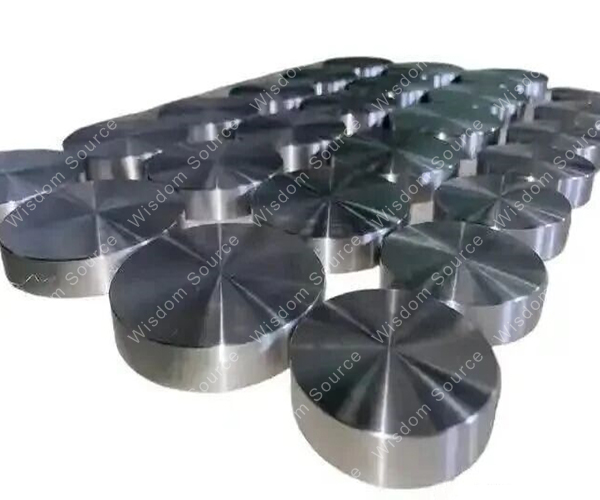
1) Mainstream Hard Abrasive Material
Commonly used materials include alumina
(molten, sintered, natural alumina), corundum, quartz, ceramics, plastics,
etc., with rich hardness gradients, which can take into account the dual needs
of deburring, strong cutting and fine mirror polishing.
2) Abrasive Setting Structure
The industry generally adopts prefabricated
abrasives to make regular structures such as dihedral, cylindrical, and
diamond-shaped. Compared with natural irregular abrasives, prefabricated
abrasives have uniform grinding strength, stable loss, higher processing
efficiency and stronger economy. They are the preferred solution for batch
finishing of titanium alloys.
3) Rolling Auxiliary Grinding Materials
For the rust removal, descaling, and rough
leveling processes of titanium alloy, it can be used with auxiliary materials
such as pumice, quartz, granite particles, shell particles, iron shavings, and
ceramic fragments to quickly remove the heavy oxide layer and stubborn stains
on the surface of the workpiece.
The key principle of selection: The
particle size of the abrasive must be adapted to the hole position and gap
structure of the workpiece, and the abrasive specifications must be accurately
matched according to the size, shape, depth and dead angle of the workpiece to
avoid problems such as stuck material, uneven grinding, local over-polishing,
and polishing blind spots.
3. Process Ratio And Key Operating Specifications
The quality of the finished product of
oscillating grinding and polishing is highly dependent on the proportion of
fillers, solution ratio and operation details, which is the core key to stable
mass production of the process.
1) Abrasive filling amount: The total
filling amount of abrasive and workpiece inside the drum is standard controlled
at 70% of the volume of the drum. A moderate filling amount can ensure
sufficient abrasive movement space and uniform friction, so as to avoid
blocking the movement of too much filling, too little filling, and insufficient
grinding force.
2) Polishing solution ratio: The filling
amount of water-soluble polishing solution accounts for about 95% of the volume
of the drum, which ensures that the workpiece and the abrasive are completely
infiltrated and wet uniform grinding is achieved.
3) Safe operation of acidic solution: If
the process needs to add acidic additives to strengthen the descaling and
passivation effects, water and acid must be added first. Direct acid addition
is strictly prohibited to prevent local corrosion of titanium alloy workpieces
by high-concentration acids and cause surface damage.
4) Solution replacement cycle: As the
processing time increases, the concentration of the polishing solution will
continue to decay, the activity will decrease, and the grinding and polishing
effect will gradually fail. The concentration needs to be tested regularly and
the liquid replaced in time to ensure the uniform quality of the batch of
products.
4. Processing Time And Quality Control
There is no fixed uniform length of time
for oscillating grinding of titanium alloy, and the processing interval ranges
from a few minutes to several hours.
The processing time, abrasive type, and
solution concentration match each other. The optimal process parameters need to
be calibrated experimentally according to the titanium alloy material state,
workpiece roughness requirements, burr size, and polishing level requirements. After
accurately matching the parameters, the finishing effect of uniform gloss, no
dead ends, no scratches, and high consistency on the surface of the workpiece
can be achieved.
5. Material Recycling And Recycling
The process has the advantages of green,
energy-saving and low-cost mass production. After the processing is completed,
the workpiece and abrasive are discharged uniformly, and the finished workpiece
and abrasive are quickly sorted through special screening and separation
equipment. Qualified and intact abrasives can be recycled and put into
production repeatedly, which greatly reduces the cost of consumables, and is
suitable for large-scale, normalized titanium alloy finishing production by
enterprises.
6. Equipment Classification And Production Adaptation
Commonly used oscillating finishing
equipment is divided into two categories: stand-alone and online.:
-Stand-alone equipment: suitable for small
batch, multi-specification, customized titanium alloy workpiece finishing, high
flexibility;
-Online equipment: suitable for large-scale
standardized production of assembly lines, high efficiency and strong
consistency, suitable for mass production and processing of large-scale
titanium products enterprises.
Enterprises can flexibly choose models
according to their own production capacity, product categories, and production
rhythm, and adapt to different production scenarios.
7. Comprehensive Process Advantages And Application Scenarios
This process breaks through the limitations
of traditional polishing and is not limited by the size, shape, and complex
structure of the workpiece. It can complete the whole process of deburring,
sharp edge chamfering, rust removal and descaling, surface leveling, and fine
polishing of titanium alloy workpieces in one stop.
Flexible processing throughout the process, no deformation, no injury to the substrate, full coverage of dead corners, good consistency of finished products, mass production, widely used in aviation, medical, mechanical precision parts, civil titanium products and other titanium alloy parts surface finishing processing, is currently an efficient, stable and cost-effective mainstream process in the field of titanium alloy finishing.