

Process Characteristics And Application Selection Analysis Of Titanium Alloy Welded Pipe
Process Characteristics And Application Selection Analysis Of Titanium Alloy Welded Pipe
As a kind of pipe product with corrosion
resistance, light weight and high strength and toughness, titanium alloy welded
pipe is gradually expanding its application in industrial fields such as
chemical equipment, marine engineering, energy equipment and special fluid
delivery systems. Titanium alloy material has low density, high specific
strength, and strong corrosion resistance, making it an important candidate
material for structural or conveying components under working conditions that
require both weight loss and durability. However, the forming process, welding
quality and selection adaptation of welded pipes directly determine their
service performance. The following analysis focuses on the process
characteristics, application logic and selection points of titanium alloy
welded pipes.
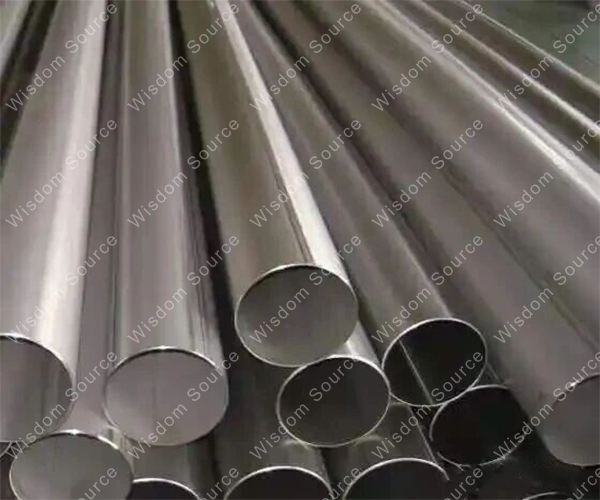
1. Material Characteristics And Process Difficulties Of Titanium Alloy Welded Pipe
Titanium alloy welded pipes are based on
titanium, and aluminum, vanadium and other alloying elements are added to form
different grades (such as industrial pure titanium TA1, TA2 and duplex titanium
alloy TC4, etc.). Their physical and chemical properties put forward special
requirements for processing technology. Titanium alloy has a low thermal
conductivity, which is about one-sixteenth that of aluminum alloy. The heat
accumulation during the welding process is serious. It needs to be closely
protected by inert gases such as argon to prevent the reaction with hydrogen,
oxygen, nitrogen and other elements at high temperatures from causing the weld
to become brittle. At the same time, the elastic modulus of titanium alloy is
low, and the residual welding stress can easily cause deformation of
thin-walled pipes, which puts forward higher requirements for heat input
control and fixture design in the molding and welding process. In addition, the
problems of tissue roughening, porosity sensitivity and cold crack tendency in
the weld area need to be controlled through strict process specifications and
testing methods.
2. Influencing Factors Of Welded Pipe Forming Process And Quality
The manufacture of titanium alloy welded
pipes usually involves sheet bending and forming, longitudinal seam welding and
subsequent correction processes. The straight seam welding process is currently
the more mainstream forming method, which is suitable for the production of
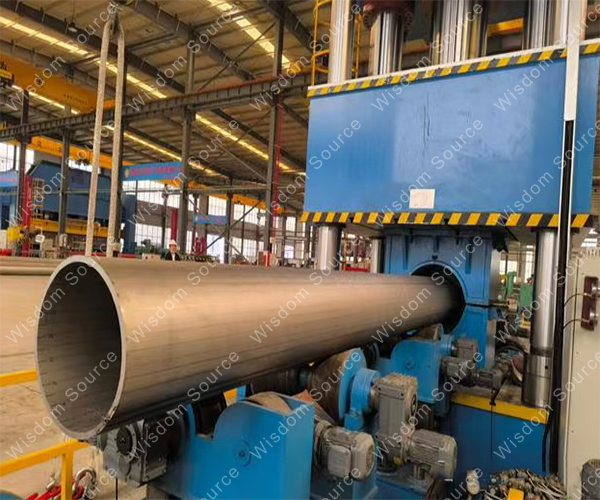
small and medium-caliber pipes; large-caliber welded pipes need to adopt a
large-diameter forming process, which requires higher equipment capacity and
mold accuracy. Most welding methods use tungsten argon arc welding or plasma
arc welding. Welding parameters such as current size, welding speed, protective
gas flow and heat input directly determine the forming quality of the weld.
The core factors that affect the quality of
finished pipe materials include the following aspects. In terms of raw
materials, the surface quality, thickness tolerance and consistency of
mechanical properties of titanium alloy sheets are the basis for the quality of
welded pipes. In terms of forming accuracy, the geometric size deviation of the
tube billet after bending and forming directly affects the welding counterpart
gap and the amount of wrong edges, which in turn affects the penetration of the
weld and the uniformity of forming. In terms of welding technology, excessive
heat input leads to overburden of the weld tissue and grain growth in the
heat-affected area, reducing the plasticity and corrosion resistance of the
joint; if the heat input is too small, it is easy to produce unsoldered or
unfused defects. In terms of follow-up treatment, the straightening, annealing
and pickling processes after welding help eliminate residual stress, improve
the tissue state and restore the surface corrosion resistance.
3. Typical Application Scenarios And Selection Logic
The application selection of titanium alloy
welded pipe needs to be comprehensively judged based on specific working
conditions, and there are significant differences in the focus of pipe
performance in different scenarios.
In the conveying system in a highly
corrosion-resistant environment, corrosive media such as seawater,
chlorine-containing solutions, organic acids or oxidizing acids put forward
extremely high requirements for the corrosion resistance of pipes. The corrosion
resistance of titanium alloy welded pipes under such working conditions is
better than that of stainless steel and ordinary alloy pipes. When selecting
the type, it is necessary to clarify the chemical composition, temperature
range and pH value of the medium to determine the appropriate titanium alloy
grade, and pay attention to whether the corrosion resistance of the weld area
matches the base material.
In the application of structural parts that
combine lightweight and high strength, the frames, brackets, exhaust pipes and
other components of aviation, aerospace and high-speed sports equipment have
higher requirements for material specific strength. At this time, it is
necessary to focus on evaluating the tensile strength, yield strength and
fatigue properties of the base material and welded joints to ensure the
structural safety margin.
In the scenario of large-caliber welded
pipes, large-flow pipelines in flue gas desulfurization systems and seawater
desalination equipment often require large-caliber specifications. Large-caliber
welded pipes have higher requirements for equipment capabilities and process
control in terms of forming, welding and straightening, and suppliers'
production experience and testing methods have become important considerations.
In terms of batch delivery and quality
consistency, for users who purchase in bulk, the batch-to-batch consistency of
the chemical composition, mechanical properties and dimensional accuracy of
titanium alloy welded pipes directly affects the progress of the project and
the service effect. It is necessary to pay attention to the process control
measures in the production process and the inspection ability of finished
products.
4. Core Technical Indicators That Need To Be Paid Attention To When Selecting Models
In the specific selection of titanium alloy
welded pipes, the following types of technical indicators should be the focus
of attention. In terms of material grades, suitable grades need to be selected
according to working conditions. Industrial pure titanium (TA1, TA2) is
suitable for general corrosion resistance scenarios, and duplex titanium alloys
such as TC4 are suitable for structural parts with high strength requirements. In
terms of mechanical properties, the minimum required values for tensile
strength, yield strength, elongation and hardness need to be clarified. In
terms of weld quality, it is necessary to specify the non-destructive testing
method (X-ray flaw detection or ultrasonic flaw detection) and the
qualification level, and clarify the allowable range of weld residual height,
bite edge, pores and cracks. In terms of dimensional tolerances, it is
necessary to control the outer diameter deviation, wall thickness deviation and
ovality to ensure the adaptability of the pipe in subsequent installation and
welding. In terms of surface state, the surface quality after annealing or
pickling treatment has a direct impact on corrosion resistance, and it needs to
be specified according to the use environment.
5. Limitations And Development Direction Of Titanium Alloy Welded Pipe
Although titanium alloy welded pipe has
outstanding overall performance advantages, its application is still subject to
certain constraints. The first is the cost factor. The price of titanium alloy
materials is much higher than that of stainless steel and ordinary alloy pipes.
Welding control has caused the cost to remain high due to the complexity of the
process, and economy has become the main obstacle to its large-scale promotion.
The second is that the welding process window is narrow, the dependence on the
skills of operators and the stability of equipment is high, and the quality
consistency is more difficult to guarantee. In addition, the forming and
welding technology of large-caliber and thick-walled titanium alloy welded
pipes still needs further breakthroughs.
Looking to the future, with the cost reduction of the localization of titanium alloy materials, the upgrading of welded pipe forming equipment and the improvement of the level of intelligent control of welding technology, titanium alloy welded pipes are expected to achieve economically feasible large-scale applications in a wider range of industrial scenarios, especially in the fields of new energy equipment, far-reaching offshore engineering and high-end chemical industry. Greater material substitution value.