

Automobile Exhaust Tail Section: Comprehensive Comparison Of The Performance Of Titanium Alloy And Stainless Steel Materials
Automobile Exhaust Tail Section: Comprehensive Comparison Of The Performance Of Titanium Alloy And Stainless Steel Materials
As the terminal core component of the
vehicle exhaust system, the tail section of the automobile exhaust gas plays an
important role in exhaust gas export, noise reduction and shock absorption, and
optimizing power working conditions. The advantages and disadvantages of its
materials directly affect the weight, power performance, high temperature
resistance, corrosion resistance life and appearance of the vehicle. In the
field of original automobile manufacturing and modification, stainless steel
and titanium alloy are the two most widely used exhaust materials. The physical
characteristics, processing technology, and performance of the two materials
are very different, and they are adapted to completely different vehicle
scenarios and performance requirements.
1. Lightweight Performance: Titanium Alloy
Achieves The Ultimate Body Weight Reduction
The lightweight body is the core key to
improving the handling and acceleration performance of automobiles, which is
particularly important in the field of performance cars and racing cars.
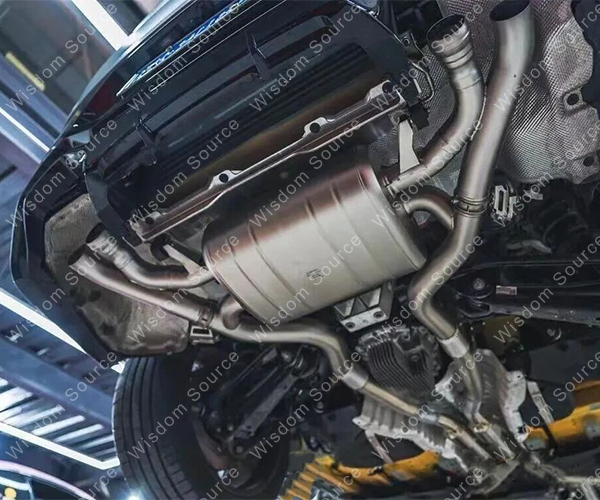
Titanium alloy has the core advantages of
low density and high specific strength. For the exhaust tail section of the
same specification and size, the weight of titanium alloy is much lower than
that of stainless steel, and the lightweight effect reaches the top level in
the industry. Significantly reduce the weight of the tail of the body and the
mass under the spring, effectively optimize the ratio of the center of gravity
of the body, reduce driving inertia, and significantly improve the acceleration
response, braking performance and cornering stability of the vehicle. It is the
preferred material for professional racing car modification.
Stainless steel material has higher
density, large self-weight, and limited lightweight improvement effect. It
cannot meet the needs of extreme performance modification, but it is fully
adapted to the conventional use standards of household passenger cars and meets
the basic working conditions of daily commuting and transportation.
2. Mechanics And High Temperature Resistance:
Titanium Alloy Is Suitable For Extreme Working Conditions
During the driving process of the vehicle,
the tail section of the exhaust gas can withstand high-temperature exhaust
scouring, high-frequency air flow impact and alternating hot and cold working
conditions for a long time, which requires extremely high material strength and
thermal stability.
Titanium alloy has excellent comprehensive
mechanical properties, is not easy to deform, soften, fatigue and damage in
high temperature environments, and has outstanding thermal stability. It can be
adapted to high-speed and high-intensity intense driving conditions for a long
time, and its service life and structural stability in extreme racing scenes
far exceed that of stainless steel.
The basic strength of stainless steel is
acceptable, and it can cope with the mild driving conditions of household
vehicles, but its high temperature resistance and thermal fatigue resistance
are weak. Under long-term high-load and high-temperature operation, pipe wall
deformation, stress aging and other problems are prone to occur, and there are
obvious shortcomings in the durability of extreme working conditions.
3. Anti-Corrosion And Durability:
Titanium Alloy Has Better Anti-Aging Ability
The tail section of the automobile exhaust
is exposed to the outdoor environment for a long time, and it is continuously
exposed to rain, moisture, exhaust sulfides, and road acid-base impurities.
Corrosion and aging are the main causes of component failure.
Titanium alloy has excellent passivation
and anticorrosive properties, a dense and stable surface oxide layer, strong
acid-base corrosion resistance and oxidation resistance, long-term use is not
easy to rust, perforate, and age, the service life is greatly extended, and the
late maintenance cost is extremely low.
Ordinary stainless steel has basic
anti-rust ability, but the material performance is limited. In weak welding
joints, bending, splicing and other processes, local corrosion can easily
occur, and corrosion and damage will occur after long-term use. It is a
conventional wear-resistant accessory.
4. The Difference In Appearance And Texture:
The Appearance And Texture Of Titanium Alloy Are Fully Upgraded
In addition to the core performance, the
appearance and visual effects of the two materials are significantly different,
which is also an important reference standard for modification users.
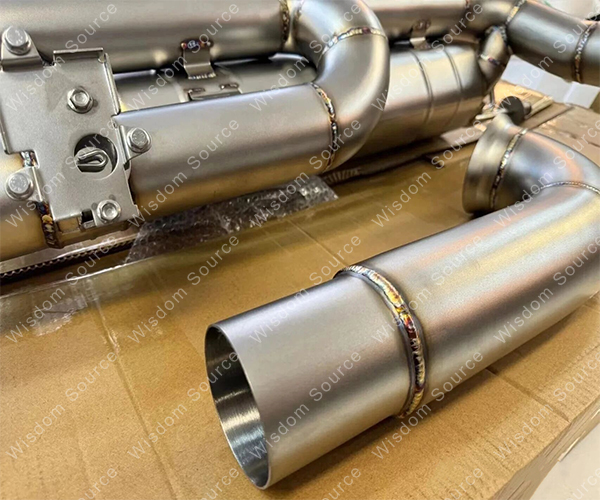
The surface of the titanium alloy pipe is
smooth and delicate, with high flatness. After high temperature work, it will
form a natural and unique gradient color. The overall refinement and high-level
sense are full, and the visual effect is very recognizable. At the same time,
the fine surface structure further assists in improving the overall
anti-corrosion protection effect.
The surface texture of stainless steel
pipes is relatively rough, the appearance is monotonous and ordinary, and there
is no characteristic visual effect. It can only meet the basic needs of use,
and it does not have the advantage of appearance modification.
5. Analysis Of Cost Performance And Scenario
Adaptation
From the point of view of application
positioning, the two materials have their own advantages and are suitable for
different vehicle needs:
1) Titanium Alloy Exhaust: Full
performance, extreme light weight, high durability, and outstanding appearance,
but high material cost, complex processing technology, and high overall price.
It focuses on performance modified cars, professional racing cars, and high-end
performance models.
2) Stainless Steel Exhaust: The price is
close to the people, the technology is mature, the performance is stable, and
the cost performance is outstanding, which is enough to cover the daily use
needs, and it is widely used in household passenger cars, ordinary mobility
models, and lightly modified vehicles.
Conclusion
Taken together, stainless steel is better
than practicality and cost-effective, and is the basic mainstream material for
civil automobile exhaust; titanium alloy has become a benchmark material in the
field of high-end performance vehicles and racing cars due to its comprehensive
advantages of lightweight, high strength, high temperature resistance, strong
anticorrosion, and high appearance value.
Car owners and modification practitioners can reasonably choose the material of the exhaust tail section according to their own vehicle positioning, driving conditions, performance requirements and budget, so as to achieve the best balance between practicality, power performance, and appearance.